Humerus is the upper arm bone and it forms two joints —shoulder joint and elbow joint. The proximal humerus is the upper end of arm bone that forms shoulder joint. Fractures of proximal humerus are common in elderly individuals suffering from osteoporosis. Fractures are caused by traumatic injuries such as a fall on outstretched hand from greater heights or motor vehicle accidents. In younger individuals a severe trauma can cause these fractures.
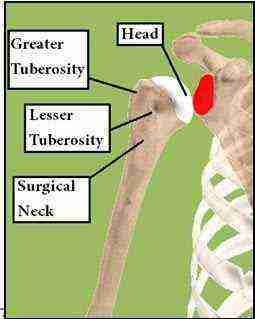
Proximal humerus fractures can be categorized into 4 groups:
- Greater tuberosity fractures: Greater tuberosity is the insertion site for attachment of rotator cuff tendons. Greater tuberosity fractures are less common and are seen in cases of shoulder dislocations and in those with osteoporosis. Greater tuberosity fragment is pulled off when cuff muscle contracts or anterior shoulder dislocates. Direct impact to the shoulder causes the tuberosity bone to break into multiple fragments Partial rotator cuff tears often accompany non-displaced fractures and these fractures can be diagnosed using MRI or diagnostic arthroscopy.
- Lesser tuberosity fractures: These fractures often caused by posterior shoulder dislocations or traumatic muscle contractions by electrical shock or convulsions. If left untreated, these fractures cause subscapularis muscle (stabilizer and mobilizer muscle) deficiency and requires a major muscle transfer procedure.
- Surgical neck fractures: Fractures of the surgical neck are most common in patients with osteoporotic bone. These fractures also damage the axillary nerve that carries sensory information from shoulder.
- Humeral head fractures: Humeral head fractures are very often in elderly individuals and chances are more in those with osteoporotic bone. These fractures occur in younger individuals by significant trauma whereas a mild traumatic injury can cause fracture in elderly individuals with osteoporosis.
In addition to above, another type of proximal humerus fractures is two, three, and four part fractures, a fracture cause multiple fragmentation of the proximal humerus.
Patients with proximal humerus fracture experience severe pain, swelling, and restricted motion of the shoulder.
Proximal humerus fracture is diagnosed by physical examination, X-ray of the affected area and/or computerized tomography (CT) scan.
Most proximal humerus fractures are minimally displaced and can be treated with conservative approaches such as use of sling to immobilize and early physical therapy to improve the functional outcome. Surgery may be necessary in displaced fractures. The multiple fragments are fixed with plates, screws, or pins and in severe cases a shoulder replacement surgery is performed.
Contact our orthopedic practice to schedule a consultation with Dr. Struhl.