AC Joint Arthritis Treatment
The acromioclavicular joint is where the collarbone meets the shoulder blade, and it is small enough that patients are frequently surprised it can be the source of significant pain. It barely moves, and it is loaded constantly, which is a combination that wears a joint out.
Steven Struhl, MD holds United States Patent 8,162,997 for an acromioclavicular reconstruction device, later acquired by the orthopedic manufacturer Smith and Nephew, and he published his long term outcomes on the technique in The American Journal of Sports Medicine. He is board certified in orthopedic surgery and separately in sports medicine, and few surgeons have spent as much time working on this particular joint. He treats AC joint conditions at his Manhattan and White Plains offices.
AC Joint Arthritis Symptoms
- Pain on Top of the Shoulder: localized precisely over the joint, and patients can usually point to it with one finger.
- Pain Reaching Across the Body: the cross body movement compresses the joint directly.
- Pain Lifting Overhead: particularly at the top of the range.
- Sleeping Discomfort: difficulty lying on the affected side.
- Clicking or Grinding: felt at the top of the shoulder with movement.
- A Visible Prominence: bone spurring making the joint appear enlarged.
The one finger localization is what most reliably separates AC joint pain from rotator cuff pain, which patients tend to describe with a whole hand over the outside of the shoulder.
What Causes AC Joint Osteoarthritis
Osteoarthritis is by far the most common of the more than one hundred conditions grouped under arthritis, and in the AC joint it is usually a wear problem rather than a systemic one.
- Repetitive Overhead Loading: weightlifting, particularly bench press and overhead press, and overhead trades.
- Cumulative Use: the joint is loaded during nearly every arm movement, so wear accumulates without any single cause.
- Prior AC Joint Separation: an old injury that altered how the joint sits, producing arthritis years later.
- Distal Clavicle Osteolysis: bone resorption at the end of the collarbone, seen in weightlifters and often called weightlifter’s shoulder.
- Age: degenerative change in this joint is extremely common on imaging after forty, and it is symptomatic in only a fraction of those people.
That last point matters. AC joint arthritis appears on a great many MRIs performed for other reasons, and whether it is causing the pain is determined by examination rather than by the scan.
How AC Joint Arthritis Is Diagnosed
Examination is the core of it. Direct pressure over the joint reproduces the pain, and the cross body adduction test compresses the joint and provokes symptoms in a way that is fairly specific. Radiographs show joint space narrowing and spurring, though the findings correlate poorly with symptoms. A diagnostic injection of local anesthetic directly into the joint is the most useful test when the picture is unclear, because relief following it confirms the joint is the pain source, and no imaging study can establish that.
AC Joint Arthritis Treatment
Most patients improve without surgery.
- Activity Modification: changing the specific loading patterns that provoke it, which in lifters usually means adjusting grip and range rather than stopping.
- Anti Inflammatory Medication: effective while inflammation drives the pain.
- Ice: simple and useful after activity.
- Physical Therapy: strengthening the surrounding musculature and correcting mechanics that overload the joint.
- Corticosteroid Injection: placed directly into the joint, offering both diagnostic information and relief lasting weeks to months.
When AC Joint Surgery Is Considered
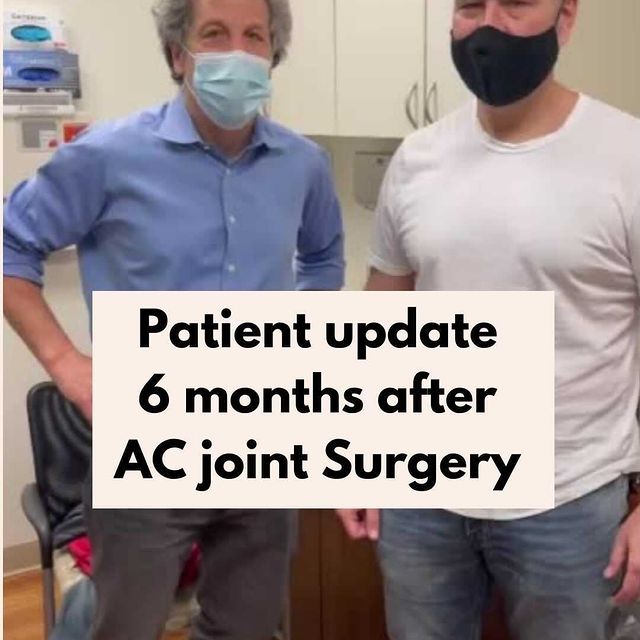
For pain that persists despite a genuine trial of the above, distal clavicle excision removes a small segment of the end of the collarbone, roughly a centimeter, which eliminates the contact producing the pain while leaving the stabilizing ligaments intact. It is performed arthroscopically in most cases, frequently alongside other shoulder arthroscopy work, and the Mumford procedure page describes it in detail. Recovery is quicker than most shoulder procedures, since nothing has to heal to bone.
Schedule an AC Joint Evaluation in New York City
Pain you can point to with one finger on top of the shoulder is a specific finding, and it deserves a specific answer rather than general treatment for shoulder pain. Dr. Struhl evaluates AC joint conditions at his Manhattan and Westchester offices. Contact our clinic to schedule your appointment.